Friday, 27 February 2015

Broadcast Now BVE article on Open Source for Film


Future of hire is in the post


Following Panavision’s purchase of post firm Light Iron in December, Dan Mulligan asks if there is greater emphasis on all-in-one rental models - and makes the case for open-source technology

Panavison’s acquisition of Light Iron combines a traditional box-rental camera facility with a newly established post and location services concern in a model that could prove to be the future for hire and post firms.

Hire companies that offer a multifaceted roster of services deliver a number of benefits to production, not least the ability to build a single workflow pipeline, which will provide more control over costs. By including post services with camera rental, it is possible to affiliate cameras with systems and workflows to create a tight and efficient production process that delivers real benefit in terms of time and cost savings.

With shooting ratios increasing and a greater variety of cameras being used, particularly small, high-quality cameras for travelling and PoV shots, anything that speeds up turnaround will be of benefit.

The quickest way to speed up the post process is to have quick access to the master data from the captured camera cards and media. This has proved to be effective, especially when it happens on location, because it allows transcodes to pass straight from the camera and data back-up utility to the edit.

So which way will it go? Will hire firms expand into on-set and post capabilities, or is there an opportunity for post firms to add hire? I believe there is scope for both.

Back in the 1990s, post firms offered free HD cameras such as the Sony F900 if you used their facilities. I can’t see this being repeated, but with developments in camera sensors, facilities’ deeper knowledge of colour and RAW workflows will inevitably lead to more location-based lab solutions.

There should still be room for the box-shifter hire companies, especially those that already support digital camera hire by providing post toolsets such as laptops and software for data ingest and dailies transcoding. Today’s new cameras are primarily a sensor first, with the build coming around this. Support is needed for all these new cameras – and that support can be considerable.

In the short term, I think dedicated box shifters will still be required, but as digital film production increases workloads and delivers more options, the need to consolidate will become more critical. However, the leap into dedicated post can be huge. Location VFX is increasingly important so integration, which we have begun at Pure Digital Services, is becoming a requirement.

At Rogue Element Films and Pure Digital, we have been running a camera rental and location post business since 2006 and 2008 respectively. We have kept them as separate entities, but the new landscape is changing this.

We are now offering an open modular camera and post system consisting of several open-source hardware and software solutions. We are combining this with efforts to build the first open-source digital cinema camera (pictured) and workflows. As a result, we are helping to evolve a creative platform that really supports the needs of film-makers, industry professionals, artists and enthusiasts.

That will allow collaboration and the opportunity to create and develop new tools for working. The aim is to create free and open technology, and make all the generated knowledge freely available to everyone, encouraging participation along the way.

As well as engaging the open-source community with the possibilities of film production, the Open Source Cinema UK project will take an active approach to establishing new software and hardware that can help deliver these results. We will be creating and developing ‘OpenFlow’, a new slate of workflows and software development for the entire film production pipeline.

From the point of view of our business, we will be able to offer exactly what the client wants and needs for the project they are undertaking.

Dan Mulligan is managing director of Rogue Element Films and Pure Digital Services and CEO of Open Source Cinema UK

TV-Bay article for BVE 2015 : Open Source for Film


TV-Bay online magazine, called KitPlus, has printed this 3 page article on Open Source for Film and TV Production.

Link here : https://www.tv-bay.com/imag/issue098/files/63.html

Pages 63-66 in the magazine, it is online and downloads inside its own browser. Enjoy.


Preperation and results are key

Planning and execution are so important as are practical results

OpenFlow and a film-focused OS– although it does sound very useful and that bringing companies together to create software for everyone's mutual benefit is obviously the foundations of Open Source, we have to bear in mind that when it comes to our marketing material and our presentations, that people can be and are naturally fairly skeptical creatures.

Telling people about a longer term broad goal is all very nice, but no one will take us too seriously and won't believe us enough to jump on board the project unless they can see, and perceive some evidence, specifics and planning to see it as realistic and get excited by it :


-evidence – are there existing functional prototypes of this project or its components, are there precedents, or a proof-of-concept?

-specifics – exactly how does the project work on a technical level, what components are there?

-planning – a realistic, researched and detailed roadmap – how are we going to get there? what resources (human/social/physical/financial) are required and where will they come from?


It is absolutely worthwhile telling people about our OpenFlow project as a future goal, but it should be in combination with talking about the day-to-day reality. We do want to encourage people to interact, share and contribute and if everyone can see what we are already working on with Apertus camera and the testing and workflow support then this will hopefully be the case, engagement and excitement in the project.

OpenFlow is a great set of solutions, but it's also quite far-off, so by introducing small practical steps and components are the all-important evidence, the effect of which lasts longer than a flash of inspiration.

To this aim next we will go to the start of the shooting process with the cameras and explain the philosophy behind the ApertusÂș Axiom 4K Open Source Cinema camera. Beta testing, image examples, and actual footage and examples so we can show what Open Source for Film Production has the capability to offer.


Why Open Source for Film Production?

Why Open Source for Film Production?

Or perhaps why our Company has decided to take this Open Source journey, what it was that garnered our interest and how we decided that by taking the Open Source approach we feel it will have a positive effect on our business model, even though the perhaps the commonly perceived wisdom is that Open Source should represent the free/libre model (which it should for a lot of areas certainly)

One of the main reasons for looking at Open Source for Film Production was the realisation that so much of what is becoming Open Source today fits into the new digital pipeline. Open Networks, Open Data, Big data all these new enviroments are applicable here also.

Another reason was the huge collaborative scope that a modern movie encompasses could be easily streamlined with a more Open approach.

In some respects I am not only advocating libre/free open source solutions but also a much more open approach to the way we use software and hardware and how that is applied to how movies are actually made. Other elements then become part of the same thinking such as ethical solutions and renewable energy sources.

Huge strides are being made to standardise the digital workflow, one area being the camera sensors and how the colour space is interpreted and what is a future proof approach to 'wrappng' the media (digital negative) into a standard file format.


For me there is huge scope here for a collaborative approach to the storing and delivery of media content, whether shot for TV or Theatrical release. Sensors, capture devices, dedicated Open Source workflow options, open operating systems for speed of transfers are all elements that can be encompassed through Open Source ethos and approach.

Monday, 23 February 2015

Thursday, 12 February 2015

Axiom 4K graded still - JPG at 4K


Below is a single image graded at 4K and exported as a JPG.

From the Axiom 4K camera using CMV12000 CMOSIS sensor.


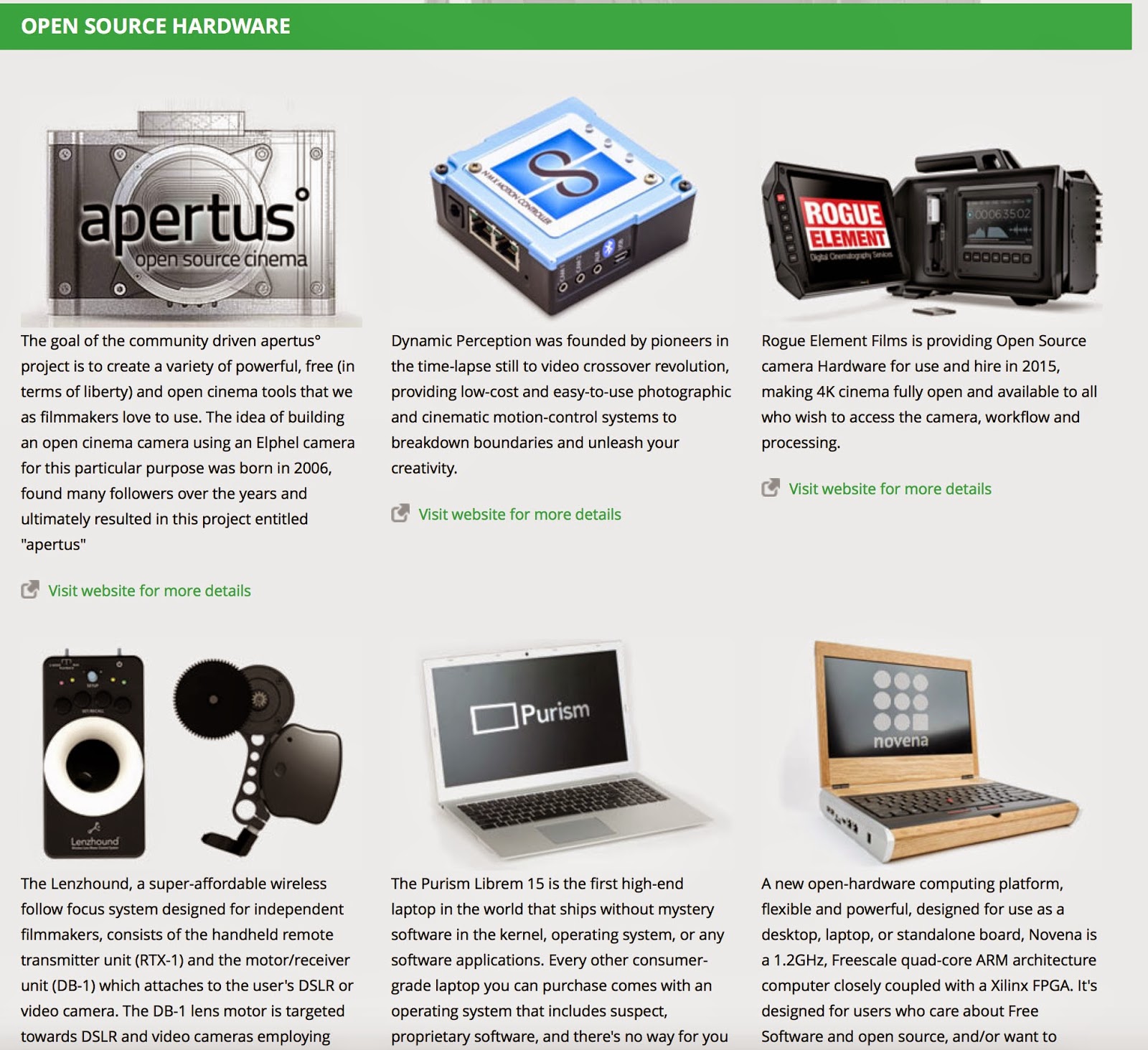
New hardware list for 2015

New hardware updates for our 2015 list on the newly updated website. 

As new options begin to open up for Open Source hardware we will continue to list what is available and who is supplying what.